BIP39 Word Checklist Download And Install: Recognizing the Official English Data
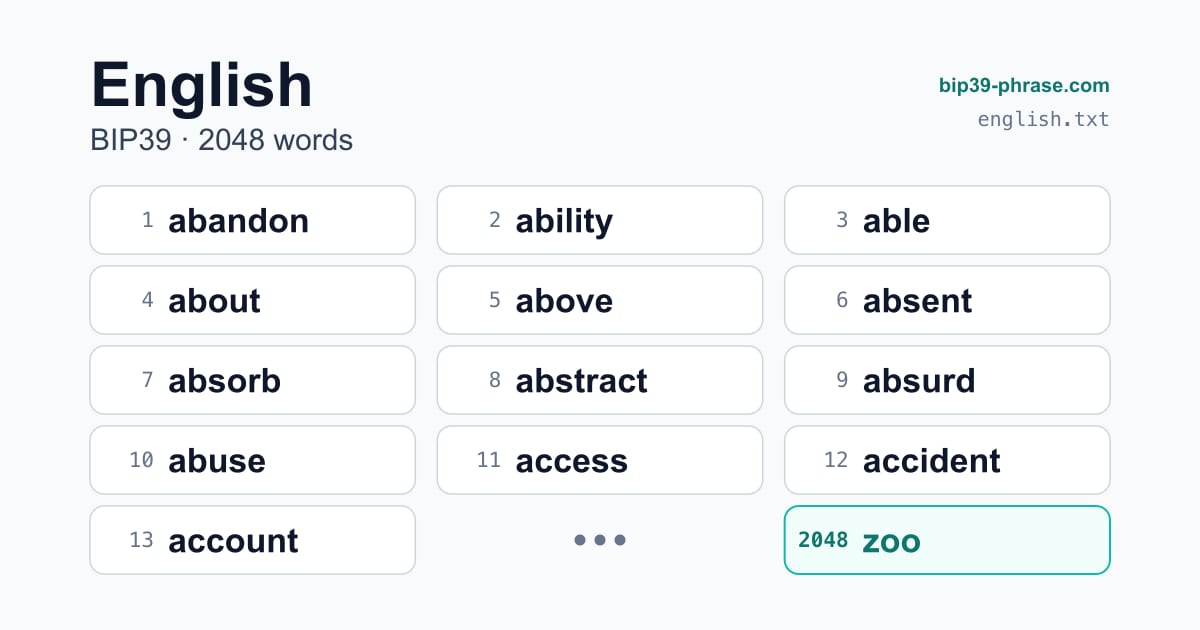
The phrase “BIP39 word list download” gets searched by people who are usually trying to do one of two things. They either want to understand what the official English file actually is, or they need it for a wallet workflow and do not want to rely on a random copy floating around the internet. That caution is healthy. With something as sensitive as a BIP39 mnemonic, the difference between the correct word list and a modified one is not academic. It changes the seed. It can change access to funds.
BIP39 is the Bitcoin Improvement Proposal titled “Mnemonic code for generating deterministic keys.” It describes a human-readable mnemonic sentence, often called a seed phrase, that can be turned into a binary seed for deterministic wallets. The standard is widely deployed, but the details matter. The word list is not just a convenience layer. It is part of the encoding system itself.
What the official BIP39 English file actually is
The official English BIP39 word list contains 2048 words. It is published in the Bitcoin BIPs repository as a plain text file. Each word is chosen to fit a very specific encoding system: the words are arranged so the crypto first four letters uniquely identify each one, similar-looking words are avoided, and the list is sorted for efficient lookup.
That design sounds simple until you think about what it has to accomplish. A mnemonic must be short enough for a human to write down and check by eye, but rigid enough for software to convert back into exact binary data. The 2048-word size is not arbitrary. It fits the 11-bit chunks used by the standard, which means each word maps cleanly to a fixed binary value.
That is why a BIP39 word list pdf, a blog copy, or a random gist is not a substitute for the official file. If the words are reordered, altered, or translated into another language, the encoding changes. For BIP39, the list is part of the math.
How the mnemonic is built from entropy
The BIP39 mnemonic code starts with entropy between 128 and 256 bits. A checksum is added, and the result is split into 11-bit chunks. Each chunk points to one word in the 2048-word list. That is how you end up with 12, 15, 18, 21, or 24 words.
The checksum is derived from the first ENT/32 bits of the SHA-256 hash of the entropy. That detail matters because it means the final phrase is not just a random assortment of words. It carries a built-in integrity check. If a single word is wrong, the checksum may fail, and the phrase may not decode properly.
This is one reason people use a BIP39 generator or a BIP39 online tool with caution. The tools are only as reliable as the implementation behind them. A proper generator must use the official list, the correct entropy size, the correct checksum logic, and the correct normalization rules. If any one of those parts is off, the result may still look like a valid seed phrase while leading to the wrong wallet.
Why the English list is the standard most people actually need
The BIP39 authors strongly discourage non-English wordlists for generating mnemonics. The reason is practical, not cultural. Most wallets support only the English list. That makes English the safest option for interoperability.
This point comes up constantly in recovery situations. Someone may have stored a BIP39 mnemonic on paper years ago, then later tried to use a BIP39 recoverer or a BIP39 mnemonic code converter and discovered that the words do not match the expected list. Sometimes the issue is a typo. Sometimes it is a non-English set of words that was entered into software expecting English. If the wallet ecosystem around the mnemonic expects the English list, the wrong language can become a dead end.
The one-way nature of the conversion makes this even more important. The specification notes that translating a mnemonic to another language does not preserve the same seed. In other words, a phrase is not portable across language lists in the way a sentence might be translated from one language to another. The seed derivation is tied to the exact word sequence and the exact list.
Downloading the BIP39 word list without making trouble for yourself
If your goal is simply to download BIP39 word list data for inspection, testing, or reference, the safest approach is to use the official English file from the Bitcoin BIPs repository. That ensures you are working from the canonical 2048-word list rather than an unofficial copy.
People sometimes keep the file in a BIP39 store, use it inside a BIP39 tool, or compare it against a local implementation during development. That is sensible. What is not sensible is treating the file as a cosmetic component. A BIP39 dictionary is not a word bank you can casually edit. The order and content are both essential.
If you are checking a download, the practical things to verify are straightforward. The file should contain 2048 entries. The words should be lowercase English words. The list should be sorted. The first four letters of every word should be enough to identify it uniquely. If those properties are missing, you are not looking at the official file or something has gone wrong in the copy.
BIP39 passphrase, seed derivation, and plausible deniability
A BIP39 passphrase is optional. If no passphrase is provided, the standard uses an empty string. If a passphrase is provided, it becomes part of the seed derivation process. The mnemonic and passphrase are normalized using UTF-8 NFKD, then passed through PBKDF2 with HMAC-SHA512, 2048 iterations, and a 512-bit output.
That is the technical heart of the standard. The mnemonic itself is not the final key. It is input to a derivation function. This is why the same seed phrase can lead to different wallets if different passphrases are used. It is also why a person can write down a mnemonic correctly and still fail to recover the expected wallet if the passphrase is forgotten.
The passphrase feature also gives the standard a form of plausible deniability. Every passphrase yields a valid seed, but only the correct one reveals the intended wallet. That is a powerful property, though it comes with an obvious operational risk. If the passphrase is lost, there is no magical recovery path hidden in the BIP39 mnemonic code. The software will not know what you meant.
What a BIP39 converter can and cannot do
A BIP39 converter is useful when you need to inspect a mnemonic, verify whether a set of words belongs to the official English list, or understand how a phrase maps to a seed. It can help you confirm whether the checksum is valid and whether a phrase is structurally correct.
What it cannot do is rescue bad assumptions. If the word order is wrong, if one word came from the wrong language list, or if the passphrase is missing, the converter will not reconstruct your intended wallet by guesswork alone. Some BIP39 tools are marketed as if they can solve almost anything, but the standard itself is deterministic, not intuitive. Precision matters more than convenience.
This is why people working with BIP39 github repositories or a BIP39 mnemonic code converter should be careful about expectations. The tool may verify syntax, but it does not know your memory. It can tell you whether a phrase fits the format, whether the checksum aligns, and whether the seed derivation rules are being followed. It cannot replace careful recordkeeping.
What the official file reveals about the design philosophy
The BIP39 word list reads like the product of a system built by people who had to imagine how humans would fail. Words are chosen to avoid ambiguity. Similar-looking words are excluded. The first four letters uniquely identify each word, which reduces the chance that handwriting, partial transcription, or a short note creates confusion.
That design matters in the real world more than people admit. A seed phrase gets copied onto paper, moved into a safe, split across backups, read under stress, and sometimes checked years later by someone who is no longer sure about spacing or capitalization. The list is meant to survive those conditions as well as possible. It is not perfect, but bip39 github it is deliberately structured.
The official English file is also compact enough to be practical. Two thousand forty-eight words is a lot to memorize, but not too much for software to handle efficiently. A BIP39 generator can turn entropy into a phrase quickly, while a verifier can map words back into bits without ambiguity. That balance between human usability and machine precision is the core achievement of the specification.
Edge cases that matter more than most people think
One edge case is language. The specification makes it clear that changing the wordlist changes the resulting seed. That means translations are not equivalent replacements. If a phrase is generated with one list, moving it to another list does not preserve meaning at the cryptographic level.
Another edge case is normalization. The standard uses UTF-8 NFKD normalization for both mnemonic and passphrase. If a tool ignores that step, a phrase may be handled differently than expected. This is not the sort of problem that shows up in casual demos, but it can matter in recovery work and interoperability testing.
A third edge case is assumption drift. People see “BIP39 words” and assume any 2048-word list will do. It will not. The order, content, and exact normalization rules are part of the standard. A copy with the right number of words can still be wrong.
BIP39 today, and why people still care about it
BIP39 remains widely used because it is simple to write down, easy to recognize, and supported across a broad range of wallets. That does not make it flawless. The BIP39 authors have identified SLIP-0039 as a proposed successor intended to address shortcomings of BIP39. That is worth noting because it tells you the standard has limits, even if those limits do not undermine its current usefulness.
For most users, though, the practical question is not whether BIP39 is theoretically perfect. It is whether they understand the file they are downloading, the seed phrase they are storing, and the passphrase behavior they are relying on. Those are the things that decide whether a wallet can be recovered later.
If you are inspecting a BIP39 word list download, the main discipline is simple. Use the official English file, keep it unchanged, and treat it as a cryptographic component rather than a reference document. If you are using a BIP39 online tool, remember that the tool is only as trustworthy as the exact list and rules it implements. And if you are handling a BIP39 mnemonic for recovery, never improvise with word order, language, or passphrase details.
The file itself is small. The consequences of getting it wrong are not.
Ends · DEVINXNHK419